
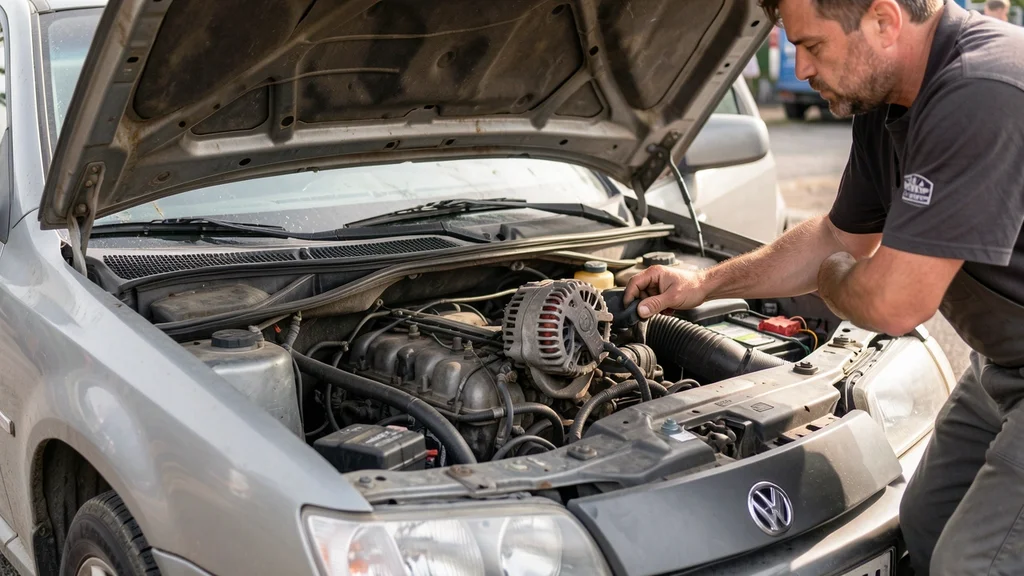
Your car’s alternator is the unsung hero keeping the battery charged and electrical systems running. If you’ve noticed dim lights, a dead battery, or strange noises under the hood, you might be wondering how long can you go with a bad alternator before serious damage occurs. Ignoring the problem can leave you stranded or cause expensive repairs, so understanding the risks and warning signs is critical.
You can typically drive 30 minutes to 2 hours with a failing alternator before the battery dies completely. Once the battery drains, the engine stalls and you’ll need a jump start or tow. Driving longer risks damaging the battery, electrical system, or even the engine.
Signs Your Alternator Is Failing
The alternator powers your car’s electrical system while the engine runs. When it starts to fail, it sends clear warning signs that demand immediate attention. Catching these early can save you from being stranded with a dead battery.
One of the first signs is dim or flickering headlights, especially at idle. The alternator can’t maintain a steady charge, causing lights to pulse or weaken. Another red flag is a dead battery that needs frequent jump starts, even after being recharged.
If your battery is relatively new but keeps dying, the alternator is likely the culprit.
- Dim or flickering headlights – Often the first visible sign of alternator trouble
- Battery warning light – Dashboard icon shaped like a battery or “ALT” label
- Weak or dead battery – Car struggles to start or needs jump starts frequently
- Slow or malfunctioning accessories – Power windows, radio, or AC work sluggishly
- Strange noises – Whining or grinding sounds from the engine bay
- Burning rubber smell – Overheating alternator belt can emit a distinct odor
- Electrical failures – Random issues with power steering, lights, or dashboard gauges
Warning: If you see smoke or smell burning from under the hood, pull over immediately. A failing alternator can overheat and cause a fire.
How Long You Can Drive With a Bad Alternator
The exact time you can drive with a failing alternator depends on several factors, including battery health, electrical load, and the severity of the alternator failure. A brand-new battery might buy you more time, while an older one could die within minutes.
In most cases, you’ll have between 30 minutes to 2 hours of driving time before the battery drains completely. This window shrinks dramatically if you’re using high-drain accessories like headlights, air conditioning, or the radio. Driving at night with lights on can cut your time in half.
Once the battery voltage drops below a critical level, the engine will stall, leaving you without power steering or brakes.
| Battery Condition | Electrical Load | Estimated Driving Time |
|---|---|---|
| New battery | Minimal (lights off, no AC) | 1.5–2 hours |
| New battery | High (headlights, AC, radio) | 30–45 minutes |
| Old/weak battery | Minimal | 30–60 minutes |
| Old/weak battery | High | 10–20 minutes |
The table above illustrates how battery condition and electrical load affect your driving time. As you can see, a weak battery combined with heavy electrical use can leave you stranded in as little as 10–20 minutes.
What Happens When You Drive With a Bad Alternator
Driving with a failing alternator doesn’t just risk leaving you stranded—it can cause cascading damage to your vehicle’s electrical system and even the engine. The alternator’s primary job is to recharge the battery and power electrical components while the engine runs. When it fails, the battery takes over, but it wasn’t designed for this role.
As the battery drains, voltage drops across the electrical system. This can cause erratic behavior in sensitive electronics like the engine control unit (ECU), transmission control module, or anti-lock braking system. Modern cars rely heavily on these computers, and voltage fluctuations can trigger error codes or even permanent damage.
- Battery drain – The battery depletes rapidly as it tries to power everything alone
- Electrical system failure – Lights dim, gauges malfunction, and accessories stop working
- Engine stalling – Without sufficient power, fuel injectors and ignition systems fail
- ECU damage – Sensitive electronics can be fried by voltage spikes or drops
- Battery damage – Deep discharging can permanently ruin a lead-acid battery
- Overheating – A failing alternator works harder, generating excess heat that can damage nearby components
- Stranded on the road – Eventually, the engine will cut off and won’t restart without a jump
Important: According to AAA, alternator failures are among the top 5 causes of roadside breakdowns. In 2023, they responded to over 2 million calls for battery and alternator issues.
Can You Jump Start a Car With a Bad Alternator
Jump starting a car with a bad alternator is possible, but it’s only a temporary solution. The jump will provide enough power to start the engine, but once you remove the jumper cables, the alternator still won’t recharge the battery. This means you’ll have very limited driving time before the battery drains again.
If you must jump start to get to a repair shop, drive directly there with minimal electrical use. Turn off the radio, AC, and any unnecessary lights. The goal is to conserve as much battery power as possible for the essential systems.
Even then, you might only make it a few miles before the engine stalls again.
| Scenario | Can You Jump Start? | Will It Stay Running? |
|---|---|---|
| Dead battery + bad alternator | Yes | No (engine will stall once cables are removed) |
| Dead battery + good alternator | Yes | Yes (alternator will recharge battery) |
| Weak battery + bad alternator | Maybe | No (battery will drain quickly) |
As shown in the table, a jump start only works as a temporary fix if the alternator is bad. The engine will stall once the jumper cables are disconnected because the battery isn’t being recharged.
How to Test Your Alternator at Home
You don’t need to be a professional mechanic to test your alternator. With a few tools and some basic knowledge, you can diagnose the problem at home. The most reliable method uses a multimeter to check voltage output.
Start by testing the battery voltage with the engine off. A fully charged battery should read around 12.6 volts. Then, start the engine and check the voltage again.
A healthy alternator should produce between 13.8 and 14.4 volts at idle. If the voltage stays the same or drops below 13.5, your alternator isn’t charging properly.
Step-by-Step Alternator Test
- Gather tools – You’ll need a digital multimeter, safety glasses, and a helper if possible
- Park safely – Ensure the car is on level ground with the engine off and parking brake engaged
- Test battery voltage (engine off) – Connect multimeter to battery terminals (red to positive, black to negative). Note the reading.
- Start the engine – Have your helper start the car while you monitor the multimeter
- Test voltage at idle – With engine running at idle, voltage should be 13.8–14.4 volts
- Test voltage at 2000 RPM – Rev the engine to 2000 RPM. Voltage should increase slightly, typically 14.0–14.5 volts
- Turn on electrical loads – Activate headlights, AC, and radio. Voltage should drop slightly but stay above 13.5 volts
- Check for fluctuations – Watch for voltage spikes or drops, which indicate alternator problems
Tip: Many auto parts stores like AutoZone, O’Reilly, or Advance Auto Parts offer free alternator testing. If you’re unsure about your results, take advantage of this service.
If your voltage readings are outside the normal ranges, it’s a clear sign your alternator needs attention. Low voltage (below 13.5) means it’s not charging properly, while high voltage (above 14.5) can indicate a faulty voltage regulator, which can damage your battery and electrical system.
Common Causes of Alternator Failure
Alternators typically last between 80,000 to 150,000 miles, but several factors can shorten their lifespan. Understanding these causes can help you prevent premature failure and extend your alternator’s life.
The most common cause is wear and tear on the alternator brushes and bearings. Over time, these components degrade, leading to reduced performance and eventual failure. Another frequent culprit is a faulty voltage regulator, which controls the alternator’s output.
If it fails, the alternator may overcharge or undercharge the battery.
- Worn brushes or bearings – Normal wear over time reduces efficiency and leads to failure
- Faulty voltage regulator – Causes overcharging or undercharging of the battery
- Corroded or loose connections – Poor electrical contact reduces alternator performance
- Overheating – Excessive heat can damage internal components and shorten lifespan
- Water damage – Driving through deep water can allow moisture to enter the alternator
- Belt issues – A loose or worn serpentine belt reduces alternator efficiency
- Electrical overload – Adding too many high-drain accessories can overwhelm the alternator
- Age – Most alternators last 5–7 years before needing replacement
| Cause | Symptoms | Solution |
|---|---|---|
| Worn brushes | Gradual power loss, dim lights | Replace alternator or brushes |
| Faulty voltage regulator | Overcharging (voltage >14.5V) or undercharging | Replace voltage regulator or alternator |
| Loose belt | Squealing noise, battery light on | Tighten or replace serpentine belt |
| Corrosion | Intermittent electrical issues | Clean connections, apply dielectric grease |
The table above outlines common alternator failure causes, their symptoms, and solutions. Addressing these issues early can prevent more costly repairs down the line.
How to Extend Your Alternator’s Lifespan
While alternators will eventually wear out, proper maintenance can significantly extend their life. Simple habits like keeping your battery in good condition and avoiding electrical overloads can add years to your alternator’s service life.
Regularly checking your serpentine belt for wear and proper tension is crucial. A loose or glaze-covered belt can’t transfer power efficiently, forcing the alternator to work harder. Similarly, keeping your battery terminals clean and corrosion-free ensures good electrical connections, which reduces strain on the alternator.
- Check belt condition regularly – Look for cracks, glazing, or wear every 6 months or 6,000 miles
- Maintain proper belt tension – A loose belt slips and reduces alternator efficiency
- Keep battery terminals clean – Corrosion increases electrical resistance and strains the alternator
- Avoid frequent short trips – Short drives don’t allow the battery to fully recharge, forcing the alternator to work harder
- Limit electrical load when idling – Turn off unnecessary accessories when the engine is idling to reduce strain
- Have the charging system tested annually – Many auto parts stores offer free testing that can catch problems early
- Address warning signs immediately – Don’t ignore dim lights or battery warnings—early intervention prevents damage
- Use quality parts – When replacing the alternator or battery, choose reputable brands for better longevity
Important: According to a study by the Car Care Council, proper maintenance can extend alternator life by up to 30%. Regular checks are especially important in extreme climates, where heat or cold can accelerate wear.
Alternator Replacement Cost
The cost to replace an alternator varies depending on your vehicle’s make and model, as well as whether you do the work yourself or hire a professional. On average, you can expect to pay between $300 to $800 for parts and labor at a repair shop.
Parts alone typically cost $150 to $400, with remanufactured alternators on the lower end and brand-new OEM (Original Equipment Manufacturer) units at the higher end. Labor costs range from $100 to $400, depending on the complexity of the job and local labor rates. Some vehicles have alternators that are easily accessible, while others require removing multiple components to reach them.
| Vehicle Type | Parts Cost | Labor Cost | Total Estimated Cost |
|---|---|---|---|
| Compact car | $150–$250 | $100–$200 | $250–$450 |
| Midsize sedan | $200–$300 | $150–$250 | $350–$550 |
| Truck/SUV | $250–$400 | $200–$400 | $450–$800 |
| Luxury vehicle | $300–$500 | $250–$400 | $550–$900 |
As shown in the table, alternator replacement costs vary by vehicle type. Luxury and larger vehicles tend to have higher parts and labor costs due to their complexity.
If you’re mechanically inclined, you can replace the alternator yourself to save on labor costs. The process typically involves disconnecting the battery, removing the serpentine belt, unbolting the old alternator, and installing the new one. However, be aware that some vehicles have tricky alternator locations that may require special tools or removing other components.
Frequently Asked Questions
Can I drive my car with a bad alternator if I keep it running?
No, this is extremely risky. While the engine might stay running as long as you don’t stop, the battery will continue to drain. Once you turn off the engine, it likely won’t restart.
Additionally, driving with a bad alternator can damage your battery and electrical system, leading to more expensive repairs.
What happens if I ignore a bad alternator?
Ignoring a bad alternator will eventually leave you stranded with a dead battery. But the damage doesn’t stop there. Continued use can drain and potentially ruin your battery, damage sensitive electronics like the ECU, and even cause the engine to stall in traffic, creating a dangerous situation.
How do I know if it’s the alternator or the battery?
The easiest way is to test both. If your car won’t start but the lights and radio work fine, it’s likely the battery. If the car starts but dies quickly, or if you see the battery light on while driving, it’s probably the alternator.
A multimeter test or free check at an auto parts store can confirm which component is failing.
Can a bad alternator cause my car to stall while driving?
Yes, absolutely. When the alternator fails to charge the battery, the battery eventually drains to the point where it can no longer power the fuel injectors and ignition system. This causes the engine to stall.
This can happen suddenly, even at highway speeds, creating a dangerous situation.
Is it safe to jump start a car with a bad alternator?
Jump starting is safe as a temporary measure to get you to a repair shop, but it’s not a long-term solution. The jump will start the engine, but once you remove the cables, the alternator still won’t charge the battery. Drive directly to a mechanic with minimal electrical use to avoid stalling again.
Final Thoughts
Driving with a bad alternator is a gamble you shouldn’t take. You typically have 30 minutes to 2 hours before the battery dies completely, leaving you stranded and potentially causing serious damage to your vehicle’s electrical system. The warning signs—dim lights, battery warnings, and electrical malfunctions—are your car’s way of telling you it needs immediate attention.
Addressing alternator issues early can save you from costly repairs and dangerous situations on the road.
Leave a Reply