
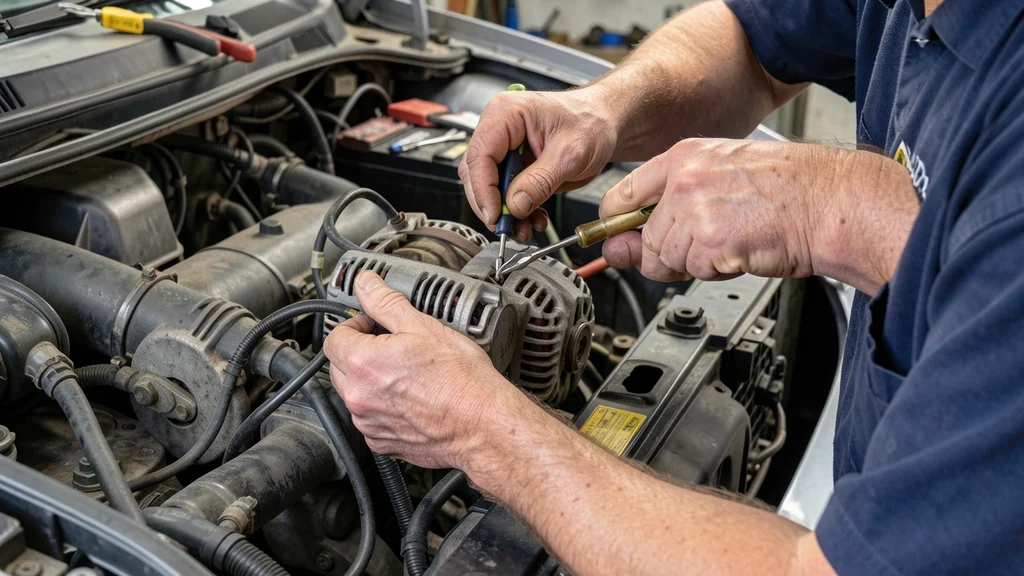
If your car’s battery light flickers or the engine stalls, can you test an alternator to see if it’s bad without a mechanic? Yes—and doing it early can save you from being stranded. A failing alternator won’t charge the battery, leaving you with a dead car.
This guide covers simple methods to check its health using basic tools or even just your senses. No advanced skills are needed, just a few minutes and attention to detail.
You can test an alternator by checking voltage at the battery with the engine running, listening for unusual noises, or observing dim lights. A healthy alternator outputs 13.8-14.4 volts. If readings are low or erratic, it’s likely bad.
Signs Your Alternator Might Be Failing
The alternator keeps your battery charged while the engine runs. When it starts to fail, your car shows clear warning signs. Ignoring these can lead to a dead battery or worse—engine failure.
Watch for these common symptoms:
- Battery warning light on the dashboard (most direct sign)
- Dim or flickering headlights, especially at idle
- Electrical accessories (radio, power windows) working sluggishly
- Engine stalling or difficulty starting
- Burning rubber smell from the alternator belt
- Whining or grinding noises from under the hood
- Dead battery that won’t hold a charge after a jump-start
According to AAA, alternator issues account for nearly 15% of all roadside assistance calls related to battery problems. Catching these signs early prevents unexpected breakdowns.
Warning: If you notice smoke or a strong burning smell, pull over immediately. A failing alternator can overheat and cause electrical fires.
Tools You Need for Testing
Testing an alternator doesn’t require a full toolbox. A few basic items will give you accurate results. Most of these are inexpensive and reusable for other car maintenance tasks.
Here’s what you’ll need:
| Tool | Purpose | Where to Get It |
|---|---|---|
| Digital multimeter | Measures voltage output | Auto parts store, online (under $20) |
| Jumper cables | Alternative testing method | Any gas station, auto store |
| Socket wrench set | Removing alternator for bench test | Hardware store, auto shop |
| Flashlight | Inspecting belt and connections | Home or auto store |
A digital multimeter is the most important tool. It gives precise voltage readings to confirm whether your alternator is charging properly. If you don’t own one, most auto parts stores lend them for free.
Method 1: Voltage Test With a Multimeter
This is the most reliable way to check your alternator. A multimeter measures the electrical output while the engine runs, giving you a clear answer in minutes.
- Park safely and turn off the engine. Open the hood and locate the battery.
- Connect the multimeter:
- Set the multimeter to DC voltage (20V range).
- Touch the red probe to the positive (+) battery terminal.
- Touch the black probe to the negative (-) battery terminal.
- Test resting voltage:
- A fully charged battery reads 12.6 volts.
- If it’s below 12.2V, charge the battery before testing the alternator.
- Start the engine and rev it to about 2,000 RPM.
- Check the voltage:
- A good alternator outputs 13.8-14.4 volts.
- If the reading is below 13.5V, the alternator isn’t charging properly.
- If the reading is above 14.5V, the alternator is overcharging (also bad).
Tip: If your multimeter has a min/max function, use it to check for voltage fluctuations. A healthy alternator maintains steady voltage.
According to AutoZone’s technical data, over 80% of alternator failures are due to worn-out brushes or faulty diodes, both of which cause low voltage output. If your reading is consistently low, the alternator is likely the culprit.
Method 2: The Headlight Test
If you don’t have a multimeter, the headlight test is a quick alternative. It’s not as precise but can reveal obvious alternator problems.
- Start the engine and turn on the headlights.
- Observe the brightness:
- At idle, headlights should be bright and steady.
- If they’re dim, the alternator may not be charging enough.
- Rev the engine to 2,000 RPM:
- If headlights brighten significantly, the alternator is likely weak.
- If they stay dim or flicker, the alternator isn’t working.
This test works because the alternator produces more power at higher RPMs. If the lights brighten when you rev the engine, it means the alternator is struggling to maintain charge at idle.
Warning: Don’t rely solely on this test. Some modern cars have voltage regulators that mask alternator problems. Always confirm with a multimeter if possible.
Method 3: Jump-Start Test
This method helps distinguish between a dead battery and a bad alternator. It’s useful if you don’t have a multimeter but have access to jumper cables and another car.
- Jump-start your car using another vehicle or a portable jump starter.
- Once running, disconnect the jumper cables.
- Turn on electrical accessories (headlights, radio, A/C).
- Observe the engine:
- If the car stays running with accessories on, the alternator is likely fine.
- If the car stalls or struggles, the alternator isn’t charging the battery.
This works because a good alternator will take over charging the battery once the engine is running. If the car dies after removing the jump cables, the alternator isn’t doing its job.
| Scenario | Likely Issue |
|---|---|
| Car starts with jump but dies after disconnecting cables | Bad alternator |
| Car starts with jump and stays running | Dead battery (alternator is fine) |
| Car won’t jump-start at all | Dead battery or bad alternator |
Method 4: Visual and Auditory Inspection
Sometimes, you can spot alternator problems without any tools. A visual or auditory check can reveal obvious issues before they leave you stranded.
Visual Signs
- Loose or broken belt: The alternator belt (serpentine or V-belt) should be tight and free of cracks. A loose belt slips, reducing charging efficiency.
- Corroded connections: Check the alternator’s wiring and battery terminals for corrosion. White or greenish buildup disrupts electrical flow.
- Leaking fluid: Alternators are sealed, but if you see oil or coolant near it, there may be a leak from another component damaging the alternator.
- Physical damage: Look for cracks, dents, or melted plastic on the alternator housing. Damage can indicate internal failure.
Auditory Signs
- Whining noise: A high-pitched whine often means the alternator bearings are wearing out.
- Grinding noise: This could indicate a failing pulley or internal components rubbing together.
- Squealing noise: Usually a sign of a slipping or worn-out belt. Replace the belt if it’s glazed or cracked.
Tip: If you hear unusual noises, turn off accessories to reduce the alternator’s load. Drive directly to a repair shop to avoid further damage.
According to NAPA Auto Care, 40% of alternator failures start with belt or connection issues. Regular inspections can prevent unexpected failures.
Common Mistakes to Avoid
Even experienced DIYers make errors when testing alternators. Avoid these pitfalls to get accurate results and prevent damage to your car’s electrical system.
- Testing with a dead battery: If the battery is completely dead, the alternator can’t charge it properly. Always charge or replace the battery first if it’s below 12.2V.
- Using the wrong multimeter setting: Set the multimeter to DC voltage (not AC or resistance). The wrong setting gives meaningless readings.
- Ignoring temperature: Alternators work harder in extreme heat or cold. Test the alternator when the engine is at normal operating temperature.
- Over-revving the engine: Don’t rev the engine excessively during testing. High RPMs can damage a failing alternator or give false readings.
- Touching the alternator while running: The alternator and belt get very hot. Avoid burns by keeping hands and tools clear.
- Assuming a new battery fixes everything: A new battery won’t solve an alternator problem. If the alternator is bad, it will quickly drain the new battery.
One of the most common mistakes is misdiagnosing a bad battery as a bad alternator. Always test the battery first to rule it out as the issue.
When to Replace vs. Repair
Not all alternator problems require a full replacement. In some cases, repairing specific components can save you money. However, modern alternators are often cheaper to replace than repair.
| Issue | Repair Option | Replace? |
|---|---|---|
| Worn-out brushes | Replace brushes (if alternator is serviceable) | No (if brushes are replaceable) |
| Faulty diode | Replace diode or rectifier bridge | No (if parts are available) |
| Bad voltage regulator | Replace regulator (if external) | No (if regulator is external) |
| Seized bearings | Not repairable | Yes |
| Burned-out stator or rotor | Not repairable | Yes |
Most modern alternators are non-serviceable, meaning they’re sealed units. If the issue is internal (like a burned-out stator), replacement is the only option. However, if the problem is external (like a loose belt or corroded connections), you can often fix it without replacing the alternator.
Average costs (U.S.):
- Alternator replacement: $400-$800 (parts + labor)
- Alternator repair (if possible): $200-$400
- DIY replacement: $200-$400 (parts only)
Tip: If you’re replacing the alternator yourself, consider upgrading to a higher-amp model if you have aftermarket electronics (like a powerful sound system). Check your car’s specifications first.
Frequently Asked Questions
Can I drive with a bad alternator?
No, you shouldn’t. A bad alternator won’t charge the battery, so your car will eventually stall once the battery drains. You might make it a few miles, but you risk being stranded.
If the battery light is on, get it checked immediately.
How long does an alternator last?
Most alternators last 80,000 to 150,000 miles or about 7-10 years. Lifespan depends on driving conditions, electrical load, and quality. Extreme heat or frequent short trips can shorten its life.
Why does my alternator keep failing?
Common reasons include excessive electrical load (aftermarket accessories), fluid leaks damaging the alternator, poor battery health, or a failing voltage regulator. If alternators fail repeatedly, check for underlying issues like a bad battery or water leaks.
Can a bad alternator damage the battery?
Yes. A failing alternator can overcharge or undercharge the battery. Overcharging causes the battery to overheat and lose electrolyte, while undercharging leads to sulfation (buildup on the plates), both of which shorten the battery’s life.
Is it the battery or the alternator?
Start the car and remove the negative battery terminal. If the engine dies, the alternator is bad. If it stays running, the battery may be the issue.
However, this test can damage sensitive electronics in modern cars, so a multimeter test is safer.
Final Thoughts
Testing an alternator is straightforward with the right approach. Start with the voltage test using a multimeter for the most accurate results. Watch for warning signs like dim lights or strange noises, and don’t ignore them.
Regular checks can prevent unexpected breakdowns and extend your car’s electrical system life. If you’re unsure, a professional diagnosis is always a smart move.
Leave a Reply